Irregular Warfare during the Revolutionary War.
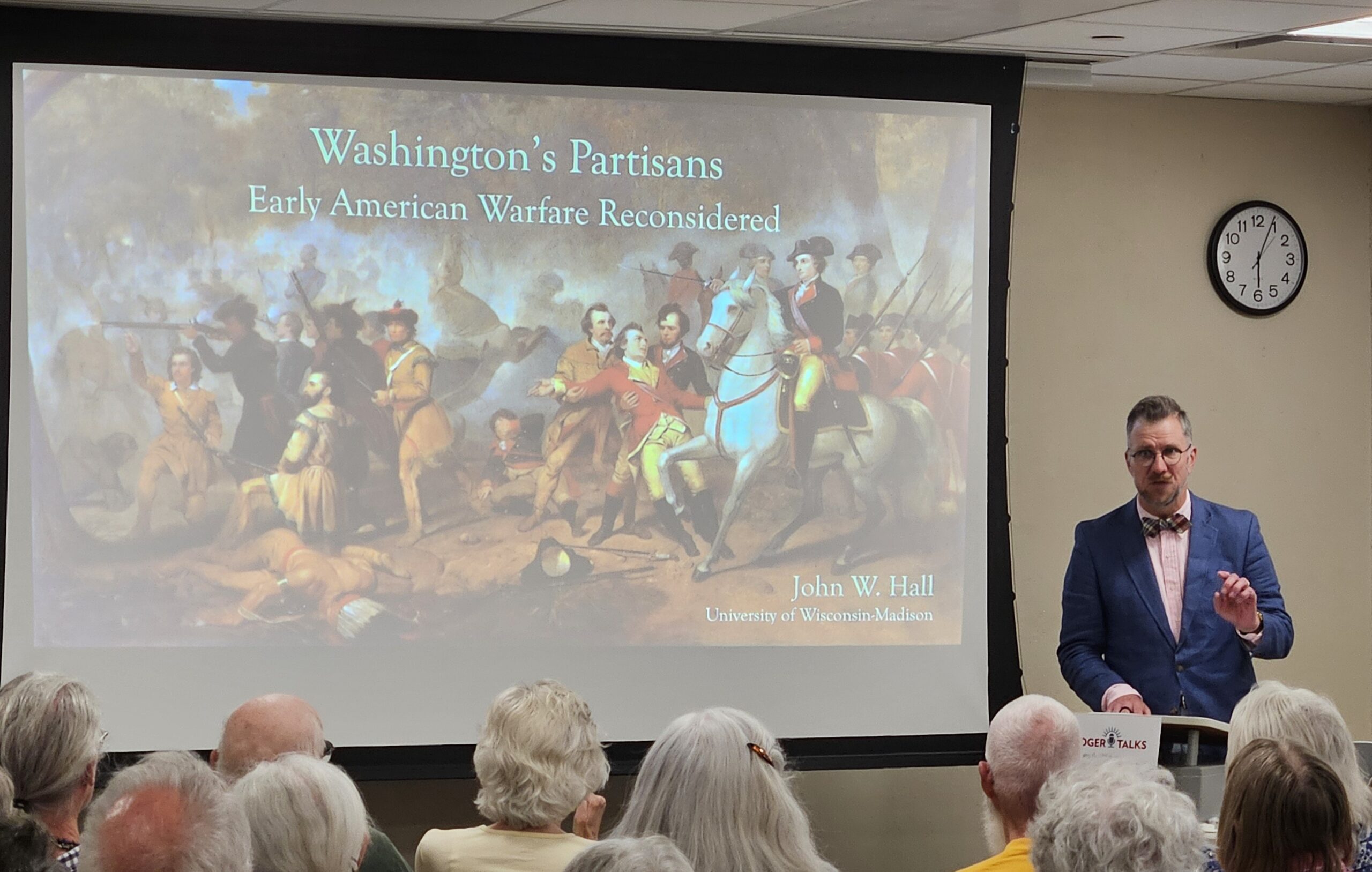
On Thursday, June 25, Professor John W. Hall of the UW-Madison History Department presented a talk, entitled “Washington’s Partisans: Early American Warfare Reconsidered,” at the Eager Free Public Library in Evansville. The Grove Society sponsored the talk jointly with the Library and UW Badger Talks as part of its observance of the 250 th anniversary of the American Revolution.
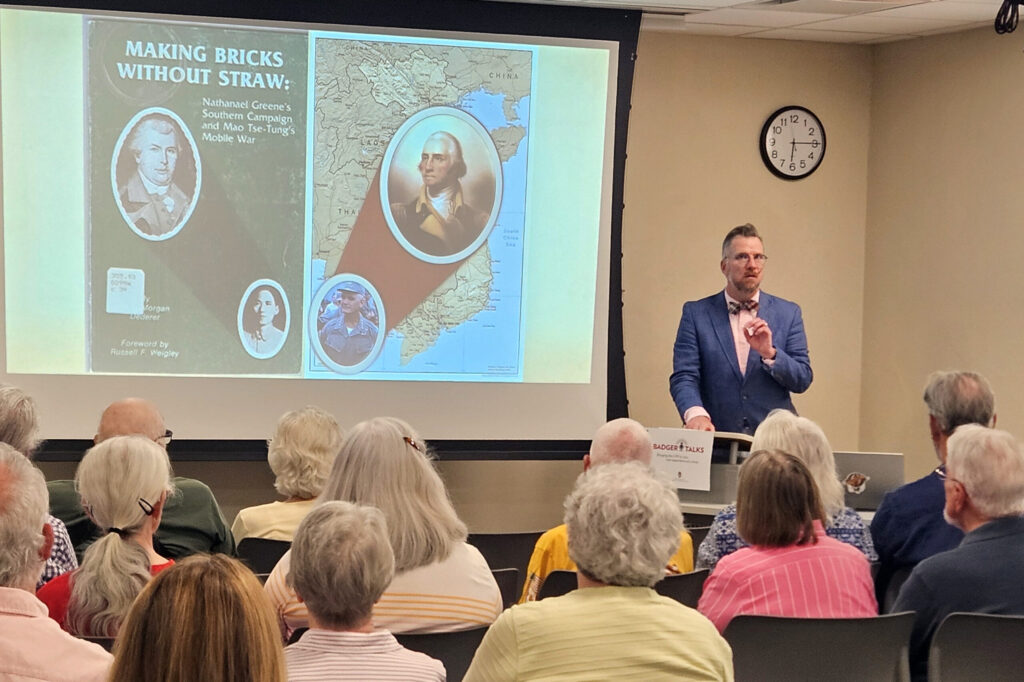
Professor Hall began his talk by challenging what he called the “received wisdom” that General (later President) George Washington led the American colonists to victory over the British by using informal, “frontier” tactics against which the professional soldiers in the British Army were unable to defend themselves. This “frontier” myth has been a durable part of US military culture as well as in American culture at large. Academic historians, Professor Hall told the audience, believe that the standard view has only a little basis in fact.
Instead, Professor Hall said, Washington was no less devoted to professional European military doctrine than his British opponents. The British, meanwhile, were far from helpless and able to adapt strategy and tactics to North American conditions. Washington was successful because he supplemented his use of professionally-trained troops with European-style “partisans” (small, highly mobile forces comparable to today’s Army Rangers or Special Forces) and “irregulars” (militia soldiers who maintained their civilian lives and took up arms only when the fighting came to their neighborhoods).
These “irregular” forces were especially important because they were the mainstay of the colonists’ defense against the larger and more powerful British. Washington reserved his professional troops for situations in which he could achieve the kind of spectacular victories that would eventually cause the British to tire of the fight. Washington’s genius lay in his ability to use all three kinds of forces effectively under North American conditions.