224 West Church Street
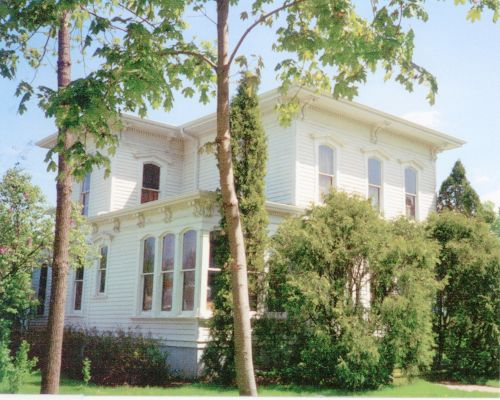
The Johnson-Morrison house, a “fine Italianate frame house” listed in the Evansville Historic District’s inventory in the National Register of Historic Places, was built in 1882. Nearly 150 years old, the house has been relatively well cared-for over its life and underwent extensive and respectful remodeling in the 1940s. Under its current owner the house has nearly completed another significant renovation, this time with the close cooperation of the Wisconsin Historical Society. It is a significant example of remodeling that brings together modernization and preservation in a creative way.
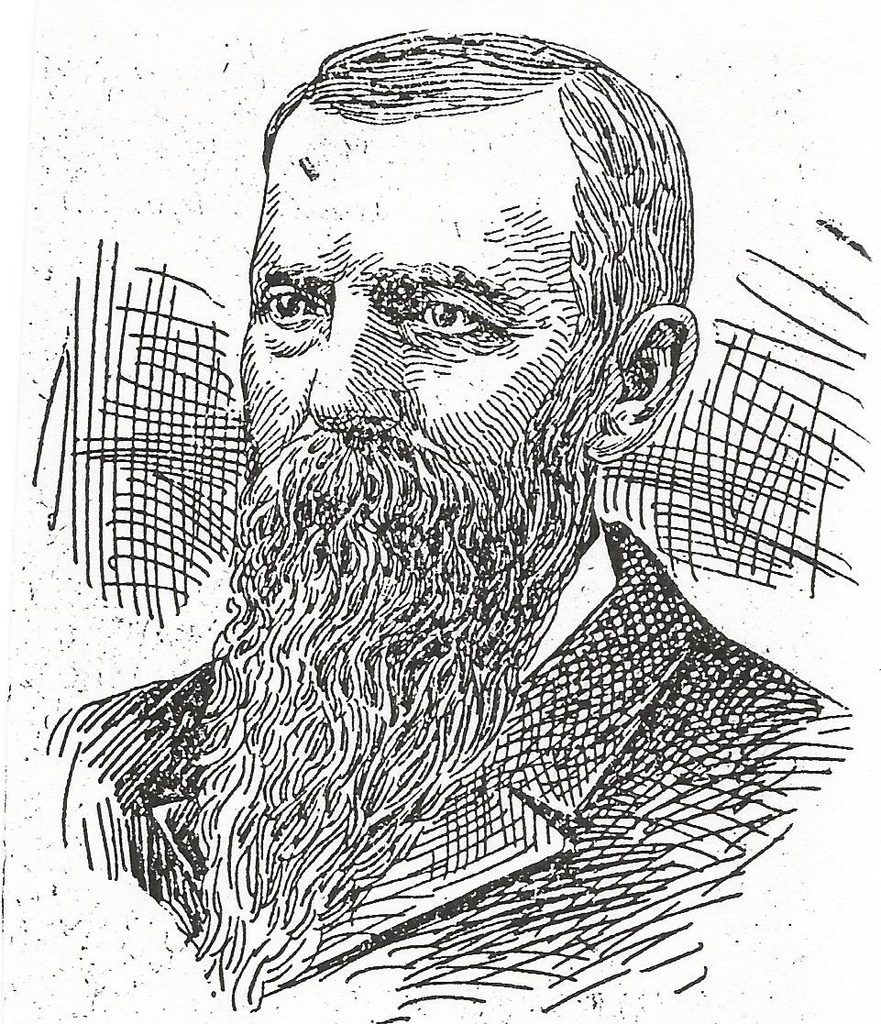
The original owner was William Johnson, born in 1842, whose parents owned a farm near the village of Union and were among the earliest settlers in the township. In 1863 William married Nancy Vernelia Frost, who had grown up on a farm nearby.
They bought land in the neighborhood, farmed it successfully, and traded it for another, 140-acre farm in 1868. They remained on that property until 1881, when they bought a vacant lot on West Church Street for $212 (roughly $7,000 today). By the Spring of 1883 they had finished a house on the property, which the Evansville Review valued at $3,000 (roughly $100,000 today).
Johnson was active in Evansville business and politics. He was president of the Village Board and, when Evansville was incorporated as a city in 1896 he was elected Alder for the First District. He belonged to the Union Anti-Thief Society, a farmers cooperative that insured its members for losses of livestock or other property to theft. Later he served as treasurer for the Union Mutual Fire Insurance Company. Nancy and William were active members of the First Baptist Church in Evansville.
The couple lived in the Church Street house for nearly fifty years, until Nancy died in 1933, at the age of 88 and one month after celebrating their 70th wedding anniversary. William died two years later, aged 92. At that point William was the oldest living native-born citizen of Union Township and much sought after as a source of local knowledge. Nancy and William each had funeral services in the house, as did William Bourbeau, who with his wife Edith bought the house from the Johnsons’ estate and who died at home shortly thereafter, in 1937. In 1941 Edith sold the house to Meta Baldwin, who had owned the funeral home at 103 West Main Street between 1910 and 1930. Meta Baldwin had been living in Chicago since then but returned to Evansville on the death of her husband, Jay, in 1940.
Meta Baldwin immediately began a major remodeling of the house, first by moving a barn that William Johnson had built at the back of the property to her own farm outside Evansville. She attached a double garage to the rear of the house, in such a way that it would not be visible from the street and not mar the exterior appearance of the house. Changes to the interior included a new furnace, a fireplace in the living room, and a “completely modern kitchen,” as well as a redesigned second floor with a new bathroom. Baldwin seems to have been careful to preserve the home’s original character while adapting it to the technology of modern life. The house remained substantially unchanged thereafter.
In 1948, with remodeling complete, Baldwin sold the house to Howard and Dorothy Morrison. While under the Morrisons’ stewardship the house appeared on the city’s application to list the district on the National Register of Historic Places and was featured in the Historical and Architectural Walking Tour of Evansville. Dorothy survived her husband by a number of years and in 1979 placed a covenant on the house with the Evansville Historic Preservation Commission to protect the integrity of the architecture.
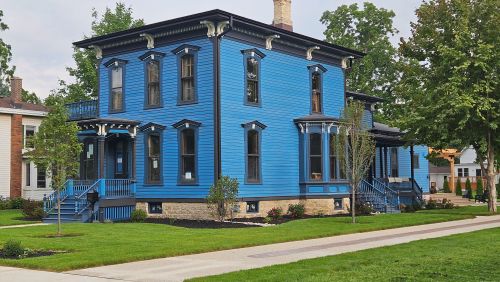
Pat Carr of Madison purchased the house in 2022 and began another extensive remodeling. He and several of the artisans who worked on the renovation will be on hand to discuss the project with visitors.